

Is God “Woke”?

In Exodus 3, it says God is deeply concerned about the cries of our sisters and brothers. As Christians, we are to interrupt injustice, not lead the fight for it. Maybe God was too “woke” and didn’t understand our need to satisfy self-interest through injustice, poverty, persecution, and legislated discrimination. Maybe, His Word didn’t take into consideration that someday we would have to live out the Imago Dei – “all are created in the image of God.“ Could God really expect us to treat everyone with dignity, honor, and respect?


Let’s face it, focusing on others before ourselves, treating all people as equal, and trusting that the Word will transform hearts requires us to give up our controlling spirit. We all have an idea of what following Jesus should look like and who should be included. But if we’re honest with ourselves, our views are often influenced by our cultural values, politics, background, and what’s currently going on in the world around us. Maybe God was too woke to understand where we are today. How could He ask us to love our enemies!


Woke is a term that refers to awareness of issues that concern social justice. Originating in the 1940’s as “being aware of the truth behind things ‘the man’ doesn’t want you to know”. Today, in culture and politics, the most prominent uses of “woke” are as a pejorative. However, despite todays vagueness, you now see evangelicals, conservative activists and Republican politicians constantly using the term. That’s because that vagueness is a feature, not a bug. Casting a really wide range of ideas and policies as too woke and anyone who is critical of them as being canceled by out-of-control liberals is becoming an important strategy and tool.


Some Christian leaders are using a blanket rejection to dismiss the realities of racism, implementing attempts to dictate the belief systems, definitions, authoritative binding, academic and ecclesiastical decisions regarding how race is to be communicated in the local church, school, and community.


Ed Stetzer, a Southern Baptist and the executive director of the Wheaton College Billy Graham Center, says that churches have become increasingly politicized. “What’s happened is that people are now sorting themselves into churches that align more with their political ideology than their theology,” he said. “They want the sermons they hear on Sundays to align with what they hear on cable news all week.”


The controversy within the Southern Baptist Conference shines a light on the generational and ideological divides churches across the country are facing today. According to Ian Lovett of the WSJ, “one faction argues the SBC should step back from its role in electoral politics to broaden its reach and reverse a 15-year decline in membership. Another faction says the denomination has been drifting to the left, and the way to retain and attract members is to recommit to its conservative roots and stay politically engaged. Each side accuses the other of straying from the SBC’s core mission.”
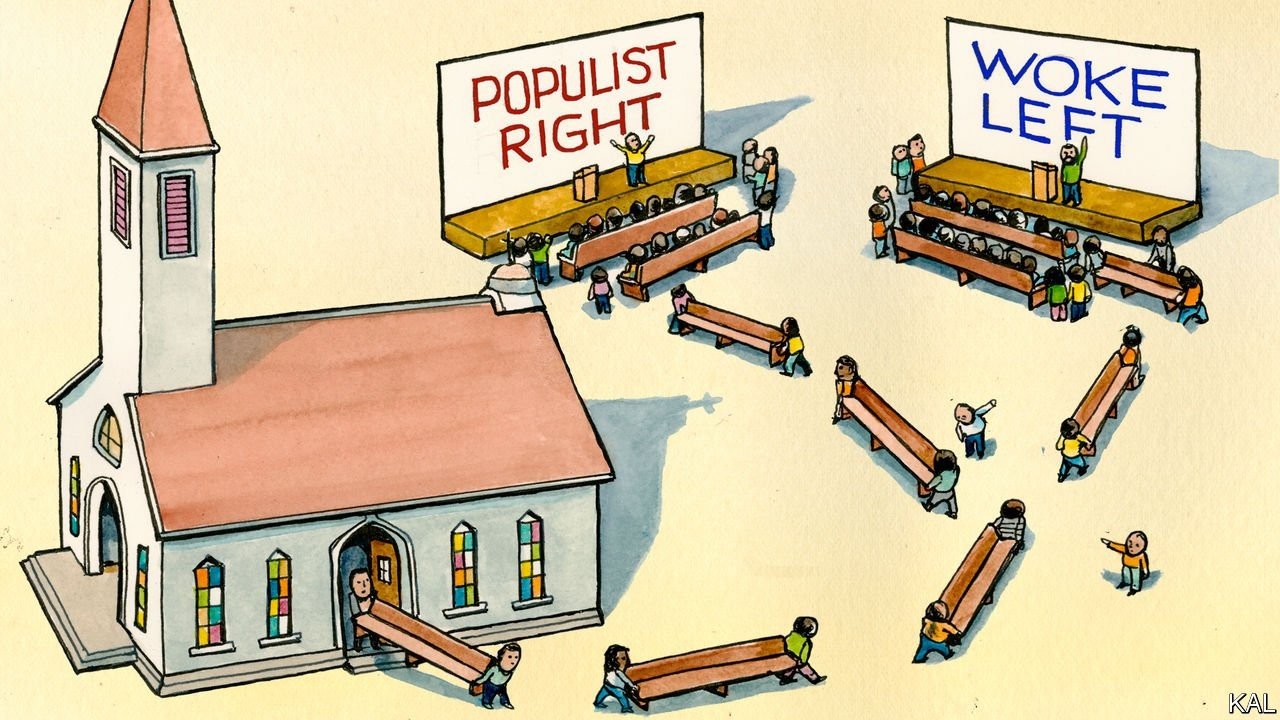


Churches across America have come to provide further evidence of this political divide. Like the SBC, factions are not focused on what Jesus is focused on – love of neighbor, mercy, kindness, and grace. Instead, focusing on demands of political loyalty, disputes about racism, assigning the most negative labeling possible to those considered the enemy, and determining who is and isn’t “conservative enough.”


“It’s like someone is bleeding out on the floor,
and these guys are fighting over
how many pints of blood a person can lose.”


SBC seminary presidents organized a letter last year denouncing one of their major points of division, critical race theory—an academic set of assertions about structural racism across society that has been a flashpoint in the denomination. They and other conservatives acknowledge historic patterns of racism but don’t want it taught to their kids, talked about, or resolved. But they also say racism can have “structural forms.” Efforts to address the central issue being lifted up are met with gaslighting, denial, minimization, and ostracization.


Ve Lu of Nonprofit AF summarizes it this way, “So many of us are in denial. Not always denial like refusing to acknowledge what exists. More so, the subtle denial that we ourselves, who are Good People fighting for a just and equitable world, could further supremacy. After all, we weren’t involved in the acts of genocide at Kamloops or Tulsa, we tell ourselves. This is what makes white supremacy so potent. It is often subtle. It happens in ways we often don’t think about.”


The cognitive dissonance some guard elicits very negative responses to any attempt to discuss this subject. Breaking through the initial discomfort and rejection of this new information causes people’s defenses to go up, and they disengage. It’s not easy to swallow the realization that you are the transgressors of micro-aggressions on a micro-scale and that you have been unwitting participants in oppression on an aggregate/macro scale.


Church, we look disingenuous to the watching world. Our witness is being weakened as we are acting like the world. We are to be “in this world, but not of this world.” In John 17, Jesus asked the Father to


“sanctify them in the truth; your Word is truth.
As you sent me into the world,
so I have sent them into the world.
And for their sake, I consecrate myself,
that they also may be sanctified in truth.” 


Jesus’s assumption in John 17 is that those who have embraced him and identified with him are sent into the world on a mission for gospel advance through disciple-making. His Word will go forth, and if you choose to represent Him your way instead of His, possibly it won’t happen through you.


Let’s determine to live as God desires—“to do justice, to love kindness, and to walk humbly with our God.


Maybe God was and is “woke”, and sent His son to live out “wokeness.”
We Can’t Heal, If We Can’t Hear

Uncertainty abounds all over the global village, from the Israel-Palestinian conflict to the Russian autocratic policies across Europe, to the economic wrestling with China, to the hijacking in Belorussia, to the struggling survival of the Sudan. We are confronted every day with tremendous uncertainty.


But it is not just distant uncertainty; it is the uncertainty that has captured our land. Geographic uncertainty as rural areas are feeling neglected, disrespected, and misunderstood. The death, isolation, and job challenges caused by the pandemic. A spike in mass shootings across the country. Unruly behavior from biting on airplanes, to spitting, throwing water bottles and popcorn at NBA Playoff games to storming PGA golf fairways. Challenges to our democracy and electoral processes. Calls from a former Presidential Advisor for a military coup. Increased institutional warfare leading to an “all in on outrage” as a strategy in Congress.


Uncertainty that has transformed how we view people. Increased racial tension with a spike in antisemitic incidents across the country and growing Asian hate crimes. Increased police scrutiny relative to violence against people of color. An uprising of political actions to hide the violent history against Native Americans and Blacks. Dehumanization makes it easier to see people as a “temptation”; someone to eliminate or consider as not worthy of equal rights or privileges.


We are subject to painful reflections about the hateful, subconscious beliefs with which some continue to drape our existence. To make it worse, as Jeremiah said in Chapter 12, “we have planted and haven’t seen a harvest.” We’ve been planting since 1619. Through the various military exploits of this nation, we’ve been planting. Through the transforming revolts of each era, we’ve been planting. Through the modification of constitutional legislation and amendments, we’ve been planting. Through marches and protests, we’ve been planting. Yet, we are still not saved.


And in our individual lives, we all have our own stories of struggle. How are you going to meet your financial challenges? How are you going to respond to the doctor’s diagnosis about you or a family member? Feelings of uncertainty about your job or job opportunities. Will you be able to avoid the foreclosure pending on your house? Or even the foreclosure already in process; will you be able to redirect it. And when the foreclosure evicts you, where will you live. How will you make your way? We are in some difficult times.


What will become of this nation as two sharply contrasting visions clash on the political horizon. The topography of their outcomes will set the direction for this nation. I asked myself, what should the Churches response be? It became apparent to me our response does not need to be complicated. Some people are looking for some theological mystery to be unraveled. As the songwriter says, “Gotta keep it real simple, get right back to ground zero. When it all comes down to this: Love God and love people.” Another songwriter adds, “What if we came down from our towers and walked a mile in someone else’s shoes. If the church wants to see a change in the world out there, it’s got to start right here.”


In the words of the honorable Bishop Arthur M. Brazier, “We can’t just be satisfied functioning within the physical and philosophical walls of the church building.  We have to apply Christian principles to the solutions of the great social problems of our time. Our faith calls us to see civic and political responsibilities through the eyes of faith and to bring our moral convictions to public life.  As believers we are called to be a community of conscience within the larger society and to test public life by the values of scripture.


The church should serve as a moral conscience to society and should seek to respond to our social, economic and political as well as spiritual needs. Faith and Justice need to become as one flesh in service of God and social transformation. Our individual activities in this regard, can be a calling only if it is viewed as a mission of service to something beyond merely our own interest.  I believe we are to articulate and live out these views in ways that are theologically faithful, exegetically careful and personally sustainable.


Pastor Rick Warren in The Purpose Driven Life opens with, “It’s not about you. The purpose of your life is far greater than your own personal fulfillment.” Too often decisions are based on self-interest and justified by that belief.


But, as with most subjects in the 21st-century U.S., opinion soon polarizes along partisan lines. This country is becoming devoid of places where differences are valued. Even in our churches, the ideological divide has become more locational than denominational as people are more likely to live and worship among people who share their worldviews and to spend free time with them. The ability to hear each other is muted by the echo chambers of political and racial speak.


When did hate become so ordinary in the church? Love, empathy, forgiveness, mercy, and compassion is disappearing. We begin to grasp divisive rhetoric and use labels as shortcuts to conversational hearing. Labeling closes minds to hearing or learning. It ignores the nuances and details of situations, then creates misinformation.


Some are raising objections to any attempt to “fill in the blanks” of American history. Any conversation that challenges an interpretation of America’s national identity neglects the trauma inflicted in creating that identity. National identity is divided along critical axis of class, faith, or race. Creating the foundation of the threefold objection – one, that this country belongs to a unique set of people. Two, the church supported slavery’s legacy. And three, slavery’s legacy still shapes American life today—an argument that is less radical than it may appear at first glance:


  • The QAnon theory is more popular today among evangelicals than people of other religions, according to a study by the conservative American Enterprise Institute.
  • States are implementing educational laws that teaching history in schools “may not define American history as something other than the creation of a new nation based largely on universal principles stated in the Declaration of Independence.”
  • The Texas Governor is threatening to withhold lawmakers pay if they don’t come back into session and vote for the Restrictive Voting Bill.
  • “We birthed a nation from nothing. There was nothing here in America before white colonizers arrived, and Native people haven’t contributed much to American culture.”
  • Backlash on the 1619 Project, which outlines the theft of labor and land, because it centers its voice on the history of Black people instead of telling a story of a glorious longstanding idea of the past – men who founded a country then built it into a Christian nation.
  • Thirty per cent of Republicans endorsed the idea that the country is so far “off track that American patriot’s may have to resort to violence” against their political opponents.
  • Senator Ron Johnson has sent letters to acting U.S. Capitol Police chief casting doubt that Officer Brian Sicknick’s death was related to the attack on the Capitol.
  • Pastor’s teaching Critical Race Theory as anti-biblical because it addresses the effect of racial bias and erosion of advances made by Blacks in the ’90s instead of only assigning individual responsibility to their outcomes.
  • The Black body is always guilty of something; therefore, whatever the police do to them is self-caused and justified.
  • Blue Lives Matter, except when conservatives attack them.
  • The Black Lives Matter Movement is a Marxist hate group and not a quest for equality, justice and humanity.
  • Biden’s presidency is illegitimate because the votes from people of color, who voted in record numbers, should not be counted.
  • Asians in America were responsible for COVID and the attacks on them are understood.
  • Native Americans were savages and their extermination by the cowboys was heroic.
  • The January 6 insurrection was a “tour of people” who are, understandably, not happy with the country’s direction.
  • Christianity and America is God’s gift to White people.


So many people live in a state of misinformation. What they are invested in banning is simply a complete and accurate accounting of American history! Claiming all discussions reflect “a displacement of historical understanding by ideology.” How do you heal the nation if facts are distorted and no one is listening to each other?


“The only problem that can’t be solved 
is the one we pretend doesn’t exist.”


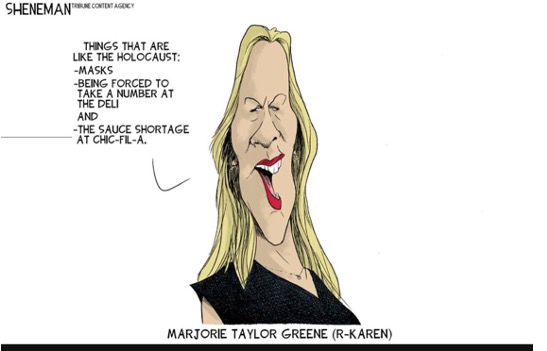
We can’t depend on the political landscape to heal our nation.  And let’s avoid any false moral equivalency between the two parties. Historically, one side defining good for its purposes and assigning evil to the opposition has led to further social violence. Democratic Rep. Ilhan Omar (D-Minn.) shouldn’t have engaged in antisemitic rhetoric. Rep. Maxine Waters (D-Calif.) shouldn’t have urged anti-racism protesters to be “more confrontational.” As reported by the Washington Post, Marjorie Taylor Greene (R-Ga.), a star of the right, was observed accosting Alexandria Ocasio-Cortez (D-N.Y.) as she was exiting the House chamber. Taylor later made negative comments connecting mask, Jews, and the Holocaust.


And yet Greene isn’t really that much of an outlier in the House Republican caucus alongside the likes of Reps. Matt Gaetz (Fla.), Louie Gohmert (Tex.), Lauren Boebert (Colo.), and other Freedom Caucus members who want a White’s only party.


“As believers we are called to be a community of conscience within the larger society and to test public life by the values of scripture.”